
Striving to provide an experience where birth is a sacred, empowering, and supported journey — rooted in trust, compassion, and excellence in midwifery care.
Work With UsWe are a group of Certified Nurse Midwives and Certified Professional Midwives (and moms!) with similar philosophies joining together to provide the best care possible. We offer personalized and compassionate care for families, with a focus on normalcy, safety, and comfort while creating a supportive environment that allows our families to feel empowered and informed.

With 26 years of midwifery practice, Julie brings extensive experience in prenatal care and birth to every family she serves. She strongly believes that pregnancy and birth are normal events in the lives of most women and loves to encourage skeptics to ask where their grandparents or great-grandparents were born!

Kara brings over 30 years of experience in women's health. This includes labor and delivery nursing, women's health physician assistant, and for the past 21 years, midwifery. She is known for her calm presence, clinical expertise, and deep belief in every woman's strength.
At Midwife Partners Homebirth, we are dedicated to supporting physiologic pregnancy, birth, and the postpartum course in the place that matters most — your home.
Birth is normal. Most pregnancies are low-risk. Your home is the most familiar and peaceful place to welcome your baby.
Care that treats every family uniquely. Pregnancy and labor are unique to you, and we honor that throughout your journey.
Rare use of technology, ultrasound, or cervical exams in pregnancy or labor. We trust birth, and we trust your body.
Eat, drink, walk, rest, labor in water — choose the position that feels right. Your body knows the way.
Invite the people you want at your birth. Husbands, partners, children, mothers, friends — whoever you want to share this moment with.
Birth at home builds a deep belief in your own capability — a foundation for everything that follows in motherhood.
With an experienced and skilled birth attendant, planned homebirth is at least as safe as hospital birth for healthy, low-risk pregnancies.
From the first prenatal visit to postpartum care, we walk every step with you.
A healthy pregnancy begins with a trusted, supportive relationship with your midwives. Our first prenatal visit typically lasts up to 90 minutes; return visits run up to 45 minutes.
We take time to address your physical and emotional needs, ensuring your prenatal experience is one you will cherish. Visits take place in our home-like office setting, and we will visit you at home at 36 weeks.

Your home is the most familiar and peaceful place for you to birth your baby. Julie and Kara will attend your birth as a team. You have the freedom to invite those you want present for this awe-filled event.
You will be encouraged to eat and drink, change positions, rest, walk, labor in a birth tub — even deliver in the tub if you wish. Recover in your own bed, snuggle your baby, and we will remain with you for typically 2–3 hours.
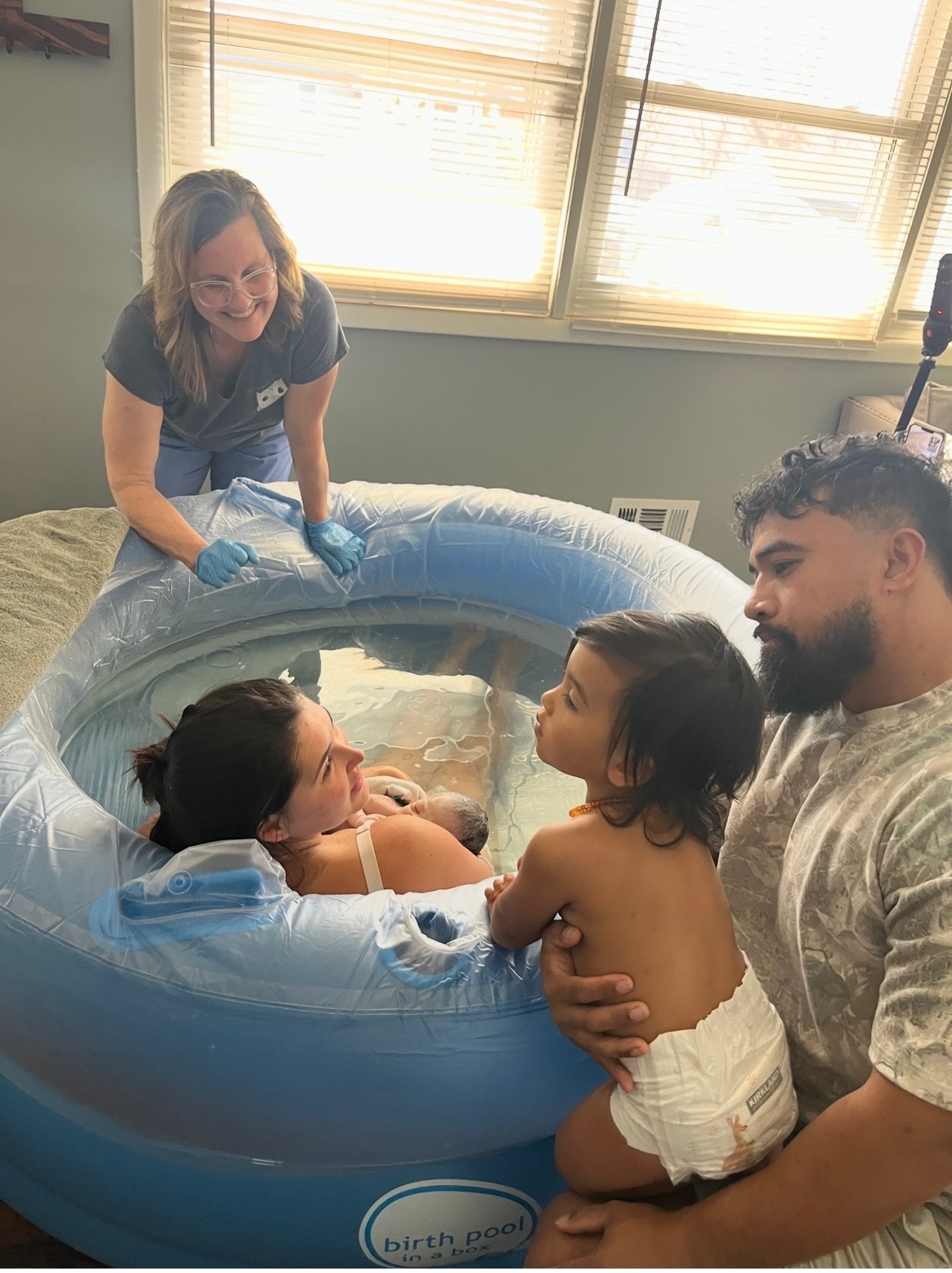
We return to your home 24–48 hours after delivery to check on you and your baby. We assess breastfeeding, perform newborn screenings, get footprints, and gather paperwork for the birth certificate.
We then follow up at home in 1–2 weeks, and you will return to the office for your 6-week postpartum visit.

Everything you need for a supported, safe, and beautifully attended birth experience at home.
Including routine prenatal labs and a 36-week visit in your home.
Included with your package if waterbirth is part of your plan.
Plus orders for any medically necessary ultrasounds during pregnancy.
Julie and Kara will attend your birth as a team.
Non-professional photos and birth video as circumstances allow, with your consent.
Two home visits (1 day, 1 week) plus a 6-week office visit for mama and baby.
State-mandated newborn screenings completed and birth certificate paperwork prepared.
Emergencies only outside of standard hours.
Answers specific to our practice. Email us to learn more or set up an interview.
This is such an interesting question. Of course we understand that it comes from our current culture of hospital birth, which is actually a very modern culture. People seem to forget that since Adam and Eve graced the Earth, women have delivered babies at home! The human race could not have survived and grown to what it is today if something did not work about normal, non-interventive, birth at home.
So is homebirth safe — Of course it is! Ask your grandmother or great-grandmother where she was born. Somewhere down the line you have relatives that were born at home! So has physician care and hospital birth saved lives? Absolutely! We are forever grateful to these experts when care from them is necessary. However, it cannot be overlooked that the United States has one of the worst maternal and neonatal outcomes of all developed countries.
And this is why homebirth is safe. There are typically no interventions with homebirth — all involved trust in birth rather than fear birth. The "emergencies" that happen in the hospital are nearly always (in healthy, term pregnancies) caused by interventions including: induction, Pitocin, artificial rupture of membranes, confinement to bed, lack of mobility, continuous fetal monitoring, IV access with or without fluids, epidural, refusal of nourishment and hydration, numerous cervical exams, strict rules regarding progress, etc.
While not every planned homebirth will be successful, transfer to the hospital is rarely ever an emergency.
YES! Just as the lack of interventions make homebirth safe, the mere use of unnecessary interventions increases the chance that you will undergo a c/s if you labor and deliver in a hospital. Let's review a few reasons why:
1. Induction — an attempt to force a baby out when neither it nor the mother's body is ready greatly increases the risk that labor will not progress and/or the baby will not be able to get in the perfect position for delivery (this includes a "big baby" which has a much greater chance of delivering vaginally if the mother goes into spontaneous labor).
2. Artificial rupture of membranes — same as #1, and additionally taking away a baby's cushioning of the cord can lead to a greater risk of fetal distress.
3. IV access — not necessary and distracting and painful.
4. Epidural — increases risk of slowing progress which will require addition of Pitocin, may decrease maternal blood pressure, may lead to fetal distress.
5. Pitocin — used to stimulate labor contractions or force them to become closer together and stronger, may cause fetal distress.
6. Limited mobility (from fetal monitoring, IV running, epidural, physician order) — prevents mother from instinctively moving around to help baby get into the ideal position for delivery.
7. Restriction of nourishment and hydration — prevents the body from having the energy it needs to physically endure labor.
8. Repetitive cervical exams — unnecessary, uncomfortable, increases risk for infection, increases risk of "failure to progress" (otherwise known as "failure of patience").
In normal, spontaneous labor, there is no induction, no artificial rupture of membranes, no IV, no epidural, no Pitocin, no limited mobility, no restriction of food and fluids, and minimal if any cervical exams. Your baby is allowed to get into the best position, your labor is allowed to progress as it should to protect your baby and you as it needs, you are not starved, you are treated individually — all of this provides you with the best opportunity for a vaginal delivery.
Since the beginning of our midwifery careers, we have attended moms who are attempting vaginal birth after cesarean. For many, they are pursuing midwifery care in order to avoid the interventions that they feel significantly contributed to the first cesarean. The risks of pursuing VBAC are similar or even less to that of any true obstetrical emergency, and thus homebirth is a safe choice. It also allows for a much higher success rate than pursing a VBAC in a hospital with unsupportive providers.
When labor is allowed to progress on its own terms, moms and babies work together in assisting the baby safely towards its entrance earthside. Without intervention in this sacred process there is much less likelihood of concerns over fetal well-being. Auscultation of the fetal heartbeat intermittently beginning in active labor, with the same doppler used at visits, provides reassurance of how baby is tolerating labor.
In nearly all cases, a baby only becomes exposed to GBS when the amniotic sac has ruptured. GBS infection is greatly reduced in babies born at home because the sac stays intact until it ruptures on its own. If the sac breaks early in labor cervical exams are avoided unless absolutely necesssary, which also greatly decreases the risk of infection. Antibiotics are not without risk and must be administered every 4 hours until delivery. As such, they are not an option with our homebirth practice.
Your homebirth fee includes rental of a birth pool if desired, however, you will need to purchase the liner, the hose, an adapter and a fishnet :).
Unfortunately, homebirth is never a guarantee. However, while a transfer is always a possibility and discussed in depth at the 36 week home visit, in actuality transfers are very rare (especially for a mother who has already had a vaginal delivery) and typically not emergent. Again, because without interventions, complications occur much less frequently. Because transfers are not common, and every labor and delivery is unique, to give a transfer rate is not truly accurate. Rather we discuss why would there be a transfer. The most common reason for a transfer of a first-time mom is exhaustion and/or need for pain relief. We discuss early on how to avoid these reasons, but sometimes it just cannot be avoided. Other reasons for transfer are: bleeding during labor; fetal intolerance to labor; prolonged labor; bleeding after delivery that while now under control may need treatment with fluids or blood; retained placenta; cord avulsion; large or significantly bleeding laceration; inability of baby to properly transition. Even these reasons may not be emergent, and we typically go by private car to the hospital. When a transfer is necessary, one of us will accompany you and your partner while another stays behind to tidy up the home.
While yes, there is blood, amniotic fluid, and other bodily fluids, homebirth surprisingly is not typically what one would consider "messy." Much is contained in the pool and the chux pads used for this purpose. While you are responsible for covering carpets or other items that you would prefer not to get soiled, you are not responsible for cleaning up after delivery. We clean up everything, and after we leave no-one would ever know that a baby had just been born — except that it is now present when it was not before!
You are welcome to have a family member or friend take photos and videos, or to hire a birth photographer. We also plan to take pictures of the labor and a video of the birth if the parents consent and circumstances allow.
Just as we believe that a woman will go into labor at the right time for her baby, we also believe that labor progresses at the speed most appropriate to each individual mother/baby dyad. We believe that a mother's body knows how to protect its baby during the labor process, and that if contractions too close together would stress out the baby, then her body will contract at a pace needed to keep the baby safe. Thus, we have seen mothers never contract closer than every 5 minutes, or contract irregularly, or stop and start, and still progress to delivery. Once again, putting all labors into a "normal" box is an archaic, cruel and sometimes dangerous concept. Patience is a virtue. Of course, if transfer seems appropriate it will be discussed, or families always have the right to transfer at any time.
Meconium stained amniotic fluid is very rare at homebirth, most likely because of the positive care received during pregnancy, lack of fear, and no interventions. When meconium is present it is usually light and has no impact on care or newborn transitioning. If there would be thick meconium, any need for transfer would be discussed.
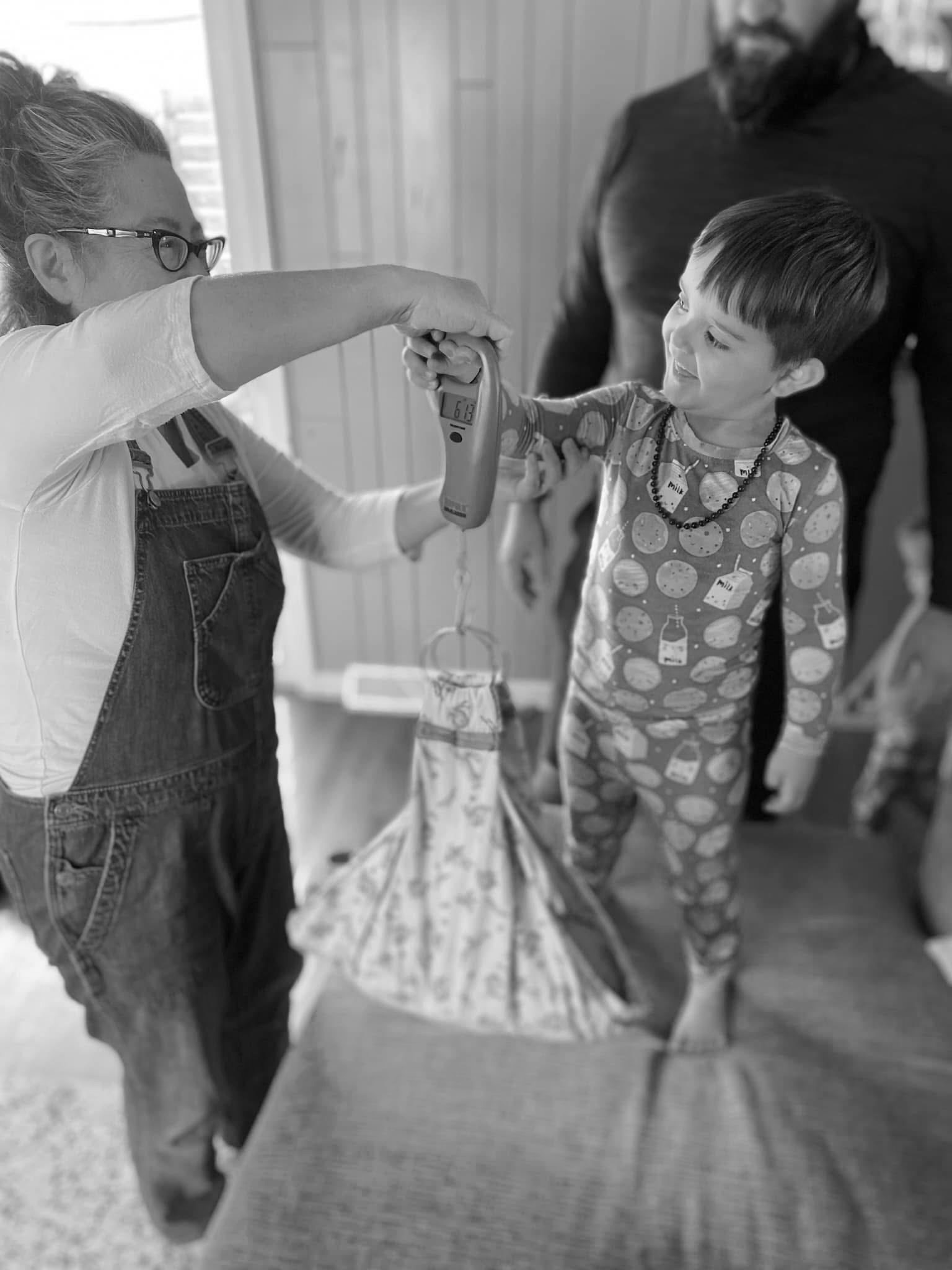
After the baby has delivered, it remains skin-to-skin with the mother without interruption. We do not overstimulate the baby with rubbing down or making it cry if it is otherwise transitioning well. The cord is left attached to the baby usually for about an hour, as it continues to provide some oxygenation and thus assistance with newborn transitioning. While the mother, partner and other children if present, are left to get to know this new life, begin bonding, and breastfeed when the baby shows readiness, we begin the clean up process. After about an hour or so, the mother is assisted to the bathroom or to shower or bathe if she so desires. We then perform the newborn assessment and dad weighs the baby. About two hours after delivery, all is typically going well and we depart.
We always laugh when we get this question. The hospital charges thousands of dollars to you and your insurance company for the privilege of delivering there. After the actual delivery, what else is there to do to earn such a sum? They have to interrupt you many times throughout the day and night to justify their charges! After homebirth, you have easy access to us if there are any questions or concerns, thus allowing you to sleep, rest, and breastfeed at your own convenience without interference and disruptions. We do return to your home within 24-48 hours to check on the two of you.
We offer newborn vitamin K injection and eye ointment, and we give you resources for circumcision if you so desire. When we return to your home for the first 24-48 hour visit, we gather information in order to submit for the birth certificate; we perform the newborn metabolic screening (the heel stick); we perform CCHD (heart defect) screening and the newborn hearing screening; we collect footprints; and we again assess the baby's weight and health status. We also, of course, assess the mother.
As stated, we make a visit to your home 24-48 hours after birth. In addition to basic mother and baby well-being, we assess breastfeeding. If there are struggles, we will recommend a lactation consult and referrals are given. If needed, we can return to check baby's weight. If all is going well at the 24-48 hour visit, we plan a return visit to your home at 1-2 weeks. At that visit the baby and mother are again assessed, and the baby is weighed. If further visits are needed, such as weight checks, those are scheduled. At 6 weeks postpartum, you will return to our office. Most of our families do not take their newborn to its care provider until after the 6 week postpartum visit.

Everyone should be prepared to respond to a term baby coming quickly at home! Even if the plan is to deliver in a hospital, parents and even doulas should have the basic knowledge to safely deliver a baby and care for the mom and baby until help arrives.
The intention of this handbook is to encourage families and others to view birth as natural and normal, not something to be feared.
This book is written in a way that invites the entire family to talk about and experience birth as a normal, family joy. To this extent it has been lovingly illustrated by one of our own special mamas!
Buy on AmazonExpect a response within 24–48 hours. We cannot wait to learn about your family.